
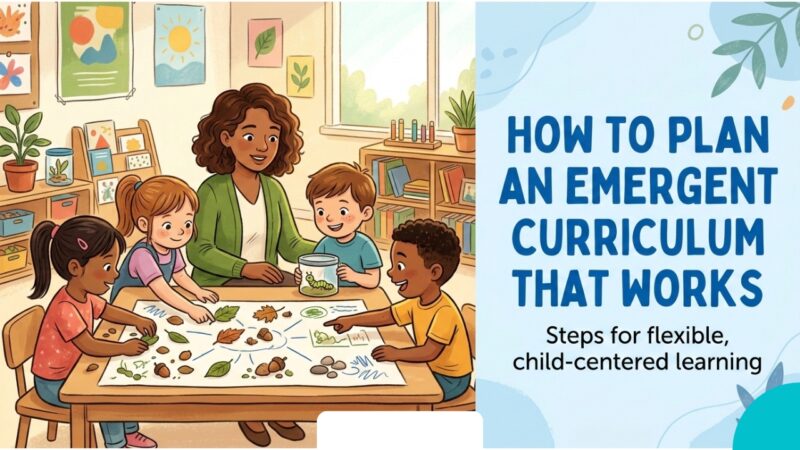
Planning an emergent curriculum can be an exciting and rewarding approach for early years educators. It’s a dynamic and flexible teaching method that adapts to the needs, interests, and curiosities of the children in your care. This guide will walk you through how to plan an effective emergent curriculum, including practical examples and tips to implement it in your early childhood setting.
What Is an Emergent Curriculum?
An emergent curriculum is a teaching approach that evolves based on the interests and questions of children. Rather than following a fixed curriculum plan, educators observe and listen to the children to understand their natural curiosities and build learning experiences around those interests. This curriculum is flexible, child-led, and responsive, allowing children to take an active role in their own learning.
In an emergent curriculum, children’s ideas and discoveries drive the direction of learning. Educators guide children through these interests, integrating key learning areas such as literacy, numeracy, social-emotional skills, and problem-solving.
Why Choose an Emergent Curriculum?
Emergent curriculum focuses on the holistic development of the child. It’s based on the principle that children learn best when they are actively involved in their learning process. Some key benefits of this approach include:
Fosters creativity: Children are encouraged to explore their ideas and express themselves.
Supports critical thinking: They learn to ask questions and seek answers in a hands-on environment.
Promotes deeper engagement: Since the curriculum is based on their own interests, children are more motivated and invested in the activities.
Builds strong relationships: It encourages collaboration and communication between children and educators.
Steps to Plan an Effective Emergent Curriculum
1. Observe and Listen to the Children
The first step in planning an emergent curriculum is observing the children closely. Pay attention to their interests, questions, and interactions. Note what they seem curious about and what topics they naturally gravitate towards. This can be done through informal observations, group activities, and one-on-one conversations with the children.
Example: If a group of children is fascinated by animals and keep bringing up topics like “Where do animals live?” or “What do they eat?”, this could lead to a unit focused on exploring animal habitats, diets, and behaviors.
2. Identify Learning Opportunities
Once you have a clear understanding of the children’s interests, the next step is to find learning opportunities within those topics. Look for ways to integrate literacy, numeracy, science, and social-emotional learning within the emerging topic.
Example: If the children are interested in animals, you could incorporate:
Literacy: Reading books about animals, practicing animal-related vocabulary.
Numeracy: Counting animals, learning about animal sizes, measuring lengths of different animal species.
Science: Exploring different habitats, learning about animal life cycles.
Social-Emotional Learning: Discussing how animals interact with one another and comparing it to the children’s own social relationships.
3. Incorporate Child-Led Activities
In an emergent curriculum, child-led activities are crucial. Allow children to explore the topic in a way that interests them most. Let them ask questions, experiment, and come up with ideas for activities.
Example: If children are curious about how animals move, let them try different movement games where they mimic animal movements (e.g., hopping like a frog, slithering like a snake). You can also encourage them to create artwork based on their favorite animals.
4. Create a Flexible, Adaptive Plan
The beauty of an emergent curriculum is its flexibility. It’s important to create a plan that’s not rigid but adaptable. As the children’s interests evolve, so should the curriculum. Be ready to modify the learning activities and direction based on their discoveries and ideas.
Example: If the animal topic leads children to show an interest in the environment and conservation, you can naturally shift the focus to topics like protecting endangered species, pollution, and sustainable practices.
5. Document and Reflect on Learning
Documenting the children’s experiences and reflections is a key part of an emergent curriculum. Keep track of their questions, discoveries, and progress. This will not only help you reflect on the curriculum’s effectiveness but also provide valuable insights into each child’s development.
Example: Create a learning journal or portfolio for each child where you document their thoughts, drawings, and observations. You can also use photographs and videos to capture moments of exploration and growth.
Examples of Emergent Curriculum Activities
Here are some practical examples of emergent curriculum activities you can use:
Animal Habitats Project: Begin by exploring animal habitats through books, field trips, and videos. Then let the children create their own animal habitats using different materials like clay, cardboard, and natural elements.
Weather Exploration: If children show an interest in the weather, allow them to track the weather over time, record temperature changes, and even conduct simple experiments like measuring rain with a homemade rain gauge.
Gardening Project: If children show curiosity about plants and the environment, introduce a gardening project where they can plant seeds, observe plant growth, and learn about the science of plants.
Conclusion
An emergent curriculum offers a flexible, engaging, and child-centered approach to early childhood education. By listening to the children’s interests, you can create a rich learning environment that fosters curiosity, creativity, and critical thinking. This curriculum model allows children to take the lead in their learning, making it a more meaningful and engaging experience.
At Early Years Shop, we offer a wide range of resources that can support your emergent curriculum planning. Whether you’re looking for learning materials, printables, or creative tools, we have everything you need to bring your curriculum to life.
Ready to Plan Your Emergent Curriculum?
Start by exploring our collection of educational resources at Early Years Shop. We offer everything from printable templates to creative activity kits that will help you implement an emergent curriculum with ease.
👉 Shop Now and find the perfect resources to support your teaching journey!
If you would like more information about our services
or if we can help you with any questions or queries,
please call us at:
(+353) 1-623-5908 or email us at reception@canavanbyrne.ie.