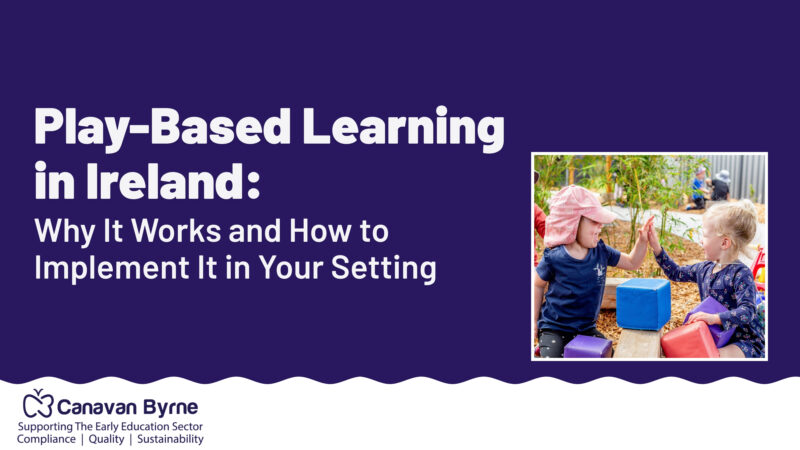
Play-based learning in Ireland’s early years sector is not a trend or an educational fashion. It is the approach to learning and development that is most strongly supported by national policy, international research, and the lived experience of skilled early years educators who have spent careers observing how young children grow, explore and make sense of the world around them. In 2026, with the updated Aistear framework now in effect, play-based learning is more centrally embedded in Irish early years practice than ever before.
Yet despite its central place in policy and practice, many settings still struggle to implement play-based learning consistently and confidently. Some educators feel pressure to introduce more structured, academic activities earlier than research suggests is beneficial. Some find it difficult to explain to parents why their child is learning so much through what looks like just playing. And some teams are uncertain about the difference between free play, guided play, and adult-led activities, and when to use each one.
This guide addresses all of these challenges. It explains why play-based learning works, what the research says, what the different types of play are and when to use them, how to design an environment that supports play-based learning, how to document it for Tusla inspections, and how to talk to parents about it with confidence.
Why Play-Based Learning Works: What the Evidence Says
The evidence that learning through play produces strong outcomes for young children is extensive and well-established. A comprehensive review by the Education Endowment Foundation found that play-based learning approaches produce a moderate positive impact on children’s learning outcomes, equivalent to approximately four additional months of progress compared to more structured approaches, with particular benefits in early literacy, language development and early numeracy.
Research from the science of learning shows that guided play, where an adult sets up a rich environment and asks probing questions while allowing the child to direct their own exploration, consistently produces greater learning gains than either free play alone or direct formal instruction. Discovery-based guided play harnesses what researchers describe as the three pillars of playful learning: it is joyful, it is actively engaging, and it is socially interactive.
In the Irish context, national research examining school readiness among parents and early years educators found that while play is widely valued as a context for learning, there is often a gap between research evidence and practice in settings. Children who experience high-quality play-based environments in their early years enter school with stronger language, social and emotional foundations than those in more formally structured settings.
These findings are consistent across countries, cultures and socioeconomic contexts. Play-based learning is not a middle-class luxury or a nice addition to a curriculum. It is the most developmentally appropriate, evidentially supported approach to early learning available.
Play-Based Learning in Aistear and Siolta
Play holds a central and explicitly named place in both of Ireland’s national early years frameworks.
In Aistear, play is described as the primary vehicle for learning in early childhood. The updated Aistear framework, in effect from September 2025, continues to emphasise play and hands-on experiences as one of its core principles, alongside the importance of active learning, relevant and meaningful experiences, and the role of the learning environment in supporting children’s exploration and discovery.
In Siolta, Standard 6 is dedicated entirely to Play. The standard defines play as the central way through which young children learn and develop, and describes what high-quality play provision looks like across different dimensions including the role of the adult, the physical environment, the variety of play opportunities offered, and the extent to which children have genuine choice and agency in their play.
Both frameworks are clear: an early years setting that does not prioritise play as the central mechanism for learning is not delivering the quality that the national frameworks describe.
The Different Types of Play and When to Use Each One
Not all play is the same, and understanding the different types of play helps educators make better decisions about how to set up their environment and when to intervene or step back. The main types of play in an early years context are:
Free Play
Free play is entirely child-directed. The adult has set up the environment but does not direct the activity. Children choose what to do, who to do it with, and how to do it. Free play builds agency, creativity, problem-solving, resilience and social skills. It is particularly important for emotional regulation because children can set their own pace and follow their own interests without external pressure.
Guided Play
Guided play is the form of play most strongly supported by learning research. The adult sets up a structured environment or activity with a specific learning goal in mind, but allows the child to explore and direct the activity. The adult’s role is to observe, ask open-ended questions, introduce new vocabulary, extend thinking and scaffold the next level of challenge without taking over. Examples include a water tray set up with measuring cups and funnels to explore capacity, a construction area with ramps and balls to explore force and motion, or a role-play corner set up as a post office to develop language and literacy.
Heuristic Play
Heuristic play involves babies and young toddlers exploring collections of natural and everyday objects, known as treasure baskets or discovery bags, using all their senses. The objects are not toys and are not designed to do anything specific. The child’s task is to discover through mouthing, handling, banging, stacking and sorting. Heuristic play is particularly powerful for children under two and supports sensory development, concentration, problem-solving and the development of schemas.
Outdoor Play
Outdoor play is not just indoor play moved outside. The outdoor environment offers children fundamentally different experiences: larger movement, different sensory inputs, exposure to natural materials, weather and the natural world, opportunities for physical challenge, and a different kind of social dynamic. The updated Aistear framework gives particular emphasis to outdoor learning and its connection to children’s developing relationship with the natural environment and sustainability values. Children should be outdoors daily, in all weather, with appropriate clothing.
Sociodramatic or Role Play
Sociodramatic play, also known as pretend play or role play, is the form of play in which children create imaginary scenarios, take on roles, develop narratives and negotiate with each other. Research suggests that sociodramatic play is one of the most cognitively demanding forms of play available to young children. It requires language, self-regulation, empathy, symbolic thinking and collaborative problem-solving simultaneously. Rich role-play provision, including diverse and open-ended props, is a mark of high-quality early years practice.
How to Design an Environment That Supports Play-Based Learning
The physical environment is the third educator, after the child and the adult, in high-quality early years practice. The way you set up your rooms and outdoor space either enables or constrains the quality of children’s play. Here are the key principles of a play-based environment:
- Provision areas are clearly defined and offer a variety of play types including construction, role play, mark-making, books, sensory and small world play
- Natural and open-ended materials are prioritised over plastic toys with single uses
- Resources are accessible to children at their height so they can make independent choices
- The environment reflects the diversity of the children, families and wider community served by the setting
- There are spaces for both active, noisy play and quieter, calmer activities
- The outdoor area is set up as an extension of the indoor learning environment with resources for exploration, construction, movement and nature connection
- The environment is reviewed and refreshed regularly based on children’s observed interests and the Aistear themes being developed
How to Document Play-Based Learning for Tusla
One of the most common concerns among early years educators is how to document play-based learning in a way that demonstrates quality to Tusla inspectors. The good news is that documentation of play-based learning does not require complicated paperwork. What inspectors look for is evidence that the programme is planned, that it is responsive to children’s interests, and that it reflects the Aistear themes and Siolta quality standards.
Effective documentation of play-based learning includes:
- Weekly or fortnightly planning notes that link your provision areas and activities to Aistear themes and learning goals
- Observations of individual children that note what they were doing, what it tells you about their development, and what you will plan next to extend their learning
- Learning stories: narrative accounts of significant moments in a child’s learning, written in a positive, strengths-based way, shared with families
- Photographs with brief explanatory captions that document the learning happening in your setting
- Evidence that your planning is responsive to children’s emerging interests rather than following a fixed topic-by-topic schedule
Tusla inspectors want to see that you can articulate why you are doing what you are doing, that your programme is intentional rather than accidental, and that children are at the centre of your planning process. A setting where educators can confidently explain the thinking behind their provision is a setting that demonstrates quality.
How to Talk to Parents About Play-Based Learning
One of the most important communication tasks for any early years educator is helping parents understand why play is learning. Many parents, particularly those whose own school experience was dominated by formal instruction, may be anxious that their child is not being prepared academically through play. Here are some approaches that work:
- Share learning stories and observations with parents regularly so they can see exactly what their child is learning through play and why it matters for their development
- Use specific language that names the learning happening in play, for example saying your child spent 20 minutes building a bridge today, experimenting with balance and problem-solving, which are the foundations of mathematical and scientific thinking
- Display an Aistear-linked planning board in your entrance or hallway that shows parents the themes and learning goals you are working on each week
- Organise a family learning event or workshop that invites parents to play alongside their children and experience for themselves how rich and demanding play-based learning is
- Use your parent communication channels, whether a newsletter, app or noticeboard, to share the research evidence on play-based learning in accessible language
At Early Years Shop, our Educational Products and curriculum support materials are specifically designed to support play-based learning in Irish early years settings, from Aistear-aligned resources for provision areas to parent communication templates and learning story frameworks.
Frequently Asked Questions About Play-Based Learning in Ireland